North America's only
FS-stage salt project
A long-life, electric-based operation accessed through inclined ramps instead of vertical shafts — next to a deepwater port, confirmed by an independent Updated Feasibility Study.
Investor updates from Atlas Salt — news and milestones, straight to your inbox.
Confirmed by the 2025
Updated Feasibility Study
Carried out by SLR Consulting with Shaft and Tunnel Consulting Services, Terrane Geoscience, Sandvik, and Tamarack Resources — detailed September 30, 2025 and filed as an NI 43-101 Technical Report on SEDAR+. The UFS builds on the 2023 Feasibility Study with optimizations in mine design, throughput, port logistics, and capital efficiency.
post-tax NPV₈
post-tax IRR
payback
initial capital
avg annual post-tax FCF
over a 24-year mine life
2023 FS → 2025 UFS
The update made the project bigger, cheaper per tonne, and materially more valuable.
| Metric | 2023 FS | 2025 UFS | Change |
|---|---|---|---|
| Production rate (Mtpa) | 2.5 | 4.0 | +60% |
| After-tax NPV₈ | $553M | $920M | +66% |
| Pre-tax NPV₈ | $1,017M | $1,683M | +65% |
| Post-tax IRR | 18.5% | 21.3% | +15% |
| Operating cost ($/t) | $27.49 | $22.00 | −20% |
| Avg operating cash flow (~EBITDA) | $211M/yr | $315M/yr | +49% |
| Avg post-tax cash flow | $121M/yr | $188M/yr | +55% |
| Payback period | 4.8 yrs | 4.2 yrs | −12% |
| Tonnes sold (LOM) | 83.7 Mt | 90.3 Mt | +8% |
| Initial capital | $480M | $589M | +23% |
| Post-tax NPV₈ / initial capex | 1.15× | 1.56× | +36% |
LOM totals or averages; all figures in Canadian dollars. Mine life is 24 years (vs 34) at the higher 4.0 Mtpa rate — the resource base supports a much longer life.
What improved in the UFS
- Optimized production plan — updated geotechnical, ventilation, and infrastructure studies supporting efficient construction and long-term operations
- Equipment integration — Sandvik continuous mining equipment improving productivity and reducing unit operating costs
- Port & logistics improvements — upgraded stockpile and shiploading configurations for high-capacity, efficient loading
- Economic resilience — updated costs and pricing assumptions, including inflationary trends
- Regulatory alignment — incorporates all post-Environmental Assessment release conditions
increase in after-tax NPV₈ from the 2023 FS to the 2025 UFS — while further de-risking execution.
UFS Technical Summary
Overview
The UFS considers developing Great Atlantic into an underground operating mine capable of producing 4.0 Mtpa of rock salt. Construction would occur over three years, with access to the deposit via twin declines. Extraction uses the room-and-pillar method with continuous mining equipment. Salt is processed to size and grade in an underground crushing and screening plant, brought to surface via conveyor, and carried by overland conveyor to the existing Turf Point port for loading onto ships destined for Canadian and American markets.
Geology & Mineral Resources
The Great Atlantic deposit is a flat-lying, laterally extensive, high-purity halite formation with minimal insoluble content. The Mineral Resource estimate is unchanged from the 2023 FS, with a new effective date of September 30, 2025.
| Category | Tonnes | Grade (% NaCl) | Contained NaCl |
|---|---|---|---|
| Indicated | 383 Mt | 96.0% | 368 Mt |
| Inferred | 868 Mt | 95.2% | 827 Mt |
CIM (2014) definitions followed. Mean grades exceed the 95.0% NaCl (±0.5%) ASTM D632-12 specification. Resources are inclusive of reserves; resources that are not reserves do not have demonstrated economic viability. Horizon-level detail in the Technical Report.
Mining Method & Mineral Reserves
Room-and-pillar underground mining using continuous miners, accessed via surface portal and conveyor decline system. Pillar dimensions and sequencing are optimized for maximum extraction with long-term stability. Production ramps from Year 1 to a 4.0 Mtpa steady state by Year 4 — approximately 11,500 tonnes per day.
| Category | Horizon | Tonnes | Grade (% NaCl) | Contained NaCl |
|---|---|---|---|---|
| Probable | 2-Salt | 39.3 Mt | 95.9% | 37.6 Mt |
| Probable | 3-Salt | 55.8 Mt | 95.9% | 53.5 Mt |
| Total | All | 95.0 Mt | 95.9% | 91.1 Mt |
Effective September 30, 2025. Minimum mining height 5.0 m, width 17.0 m; planned process recovery 95%; bulk density 2.16 t/m³. Reserves grew 7.9% versus the 2023 FS.
Processing & Product Handling
Salt is crushed and screened underground to market specifications, conveyed to surface, and transported to the port via covered conveyor. No chemical processing or water usage is required — only an anti-caking agent applied immediately prior to shipment.
Project Location & Infrastructure
Located near St. George's, Newfoundland — approximately 3 km from the Trans-Canada Highway and adjacent to deepwater port facilities with direct access to tidewater shipping routes serving Eastern Canada, the U.S. Northeast, and Western Europe.
- Dedicated port storage and shiploading system designed for 4.0 Mtpa throughput
- Continuous conveyor-fed shiploader with optimized cycle times to minimize demurrage
- Surface stockpile capacity of ~72 kt — about 6.5 days of average production
- ~10 MW connected load at steady state, from the provincial grid via dedicated substation
- No camp required — the project benefits from established nearby communities
Cash Flow Model Basis
SLR's cash flow model is based on a 24-year mine plan at 4.0 Mtpa — the resource base allows for a much longer life. The schedule includes a four-year ramp-up (1.7 → 2.8 → 3.9 → 4.0 Mtpa). Pre-construction activities are assumed to commence in 2026, construction in 2027, and salt production in 2030. Salt prices escalate 4.0% annually to a 2030 base (consistent with public technical reports on existing North American salt operations) and 2.0% thereafter; costs inflate 2.0% annually. The 2025 salt price assumption is $81.67/t FOB port, set by an independent third-party marketing study.
Capital Costs
Class 3 AACE estimate based on feasibility-level engineering and vendor quotations (Q3 2025 data): initial capital accuracy −10%/+30%, operating costs −10%/+20%.
| Area | Initial ($M) | LOM Sustaining ($M) | Total ($M) |
|---|---|---|---|
| Underground mine development & equipment | $203 | $545 | $748 |
| Processing plant | $42 | $31 | $73 |
| Surface infrastructure & port facilities | $132 | $33 | $165 |
| Owner's costs & indirects | $134 | — | $134 |
| Contingency (~15.1%) | $77 | — | $77 |
| Total | $589 | $609 | $1,198 |
Sustaining capital averages ~$26.5M/yr, primarily underground development, conveyor extensions, and equipment replacement.
Operating Costs
Built from first principles: vendor quotations, Newfoundland-specific labour and power assumptions, and benchmarking against comparable underground salt operations.
| Item | LOM Total ($M) | Unit Cost ($/t) |
|---|---|---|
| Mining | $1,354 | $15.00 |
| Processing & handling | $297 | $3.29 |
| G&A | $335 | $3.71 |
| Port operations | $557 | $6.17 |
| Total | $2,543 | $28.17 |
Sensitivity Analysis
Economics are most sensitive to salt price, then capital and operating costs. Even under downside scenarios the project remains robustly economic.
| Scenario | −10% | Base | +10% |
|---|---|---|---|
| Salt price → post-tax NPV₈ | $474M | $920M | $1,483M |
| Salt price → post-tax IRR | 16.9% | 21.3% | 25.0% |
| Capex → post-tax NPV₈ | $963M | $920M | $891M |
| Opex → post-tax NPV₈ | $973M | $920M | $881M |
Economic Outcomes vs 2023 FS
| Metric | 2023 FS | 2025 UFS | Change |
|---|---|---|---|
| Pre-tax payback | 4.2 yrs | 3.6 yrs | −14% |
| Pre-tax IRR | 23.4% | 27.1% | +16% |
| Pre-tax NPV₅ | $1,900M | $2,759M | +45% |
| Pre-tax NPV₈ | $1,017M | $1,683M | +65% |
| Pre-tax NPV₁₀ | $681M | $1,220M | +79% |
| Post-tax payback | 4.8 yrs | 4.2 yrs | −12% |
| Post-tax IRR | 18.5% | 21.3% | +15% |
| Post-tax NPV₅ | $1,089M | $1,574M | +45% |
| Post-tax NPV₈ | $553M | $920M | +66% |
| Post-tax NPV₁₀ | $349M | $609M | +74% |
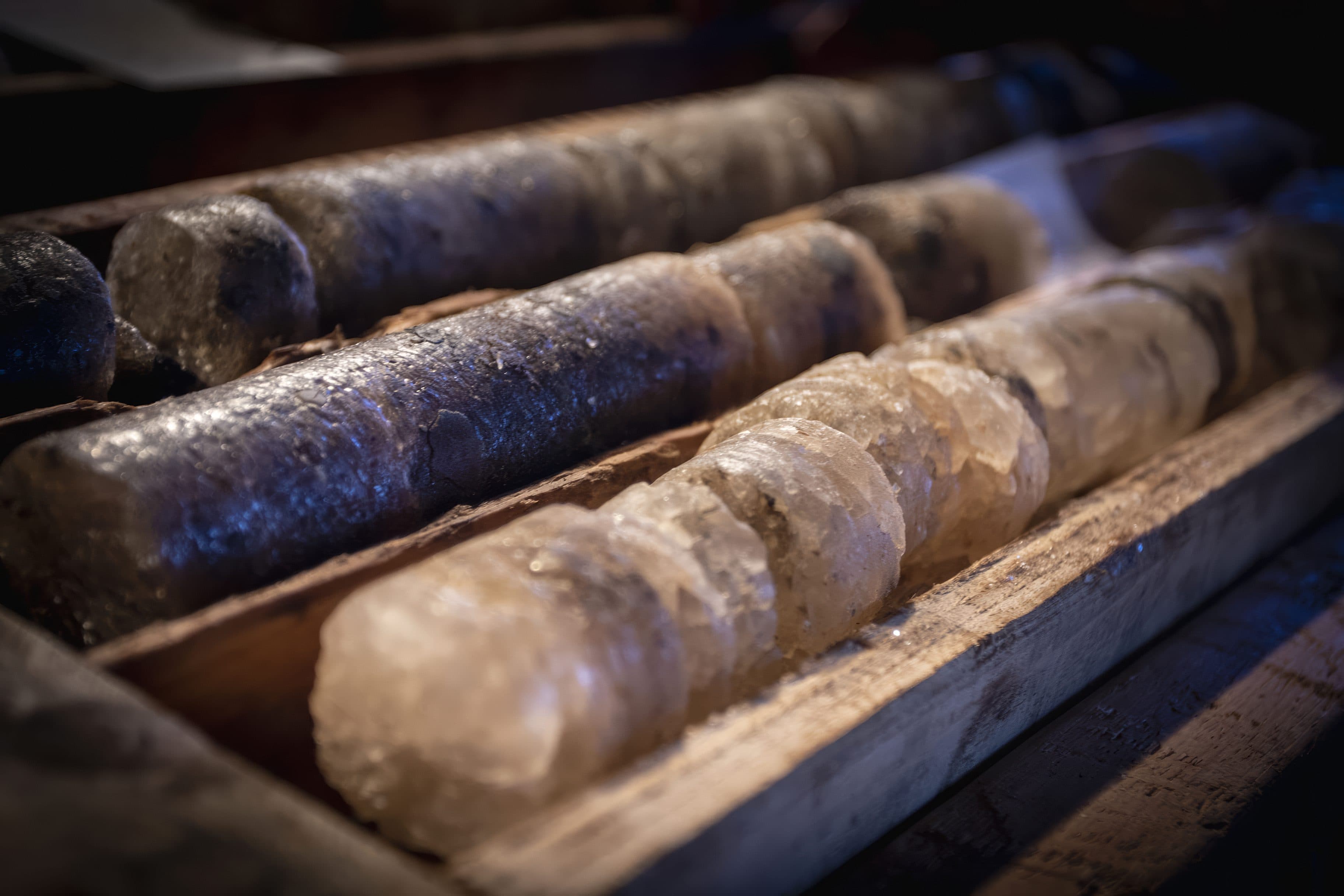
“Some of the best salt cores
I've seen in my 30-year career”
— Rowland Howe, Director. The man who ran the world's largest salt mine, on the drill core from Great Atlantic.
Highlights
- High-grade, homogeneous, very thick and large — and unusually shallow by industry standards
- NI 43-101 independently verified: 383 Mt Indicated @ 96.0% NaCl and 868 Mt Inferred @ 95.2% NaCl, with Probable Mineral Reserves of 95.0 Mt @ 95.9% NaCl (Sept 30, 2025)
- Every widely-spaced 2022 drill hole hit thick salt beds between ~250 m and ~335 m depth
- Final pre-feasibility hole CC-9 cut 333 metres (1,092 ft) of salt starting from just 243 m
- Drilling has not found the limits of this 2.5+ km deposit, trending northeast toward Turf Point
Great Atlantic shares similar geological characteristics with Compass Minerals' Goderich mine — in operation since the 1950s, 600 metres under Lake Huron, accessed through three vertical shafts. Great Atlantic starts more than 300 metres shallower, features a salt bed thicker by orders of magnitude, and will become the first major North American salt deposit accessed through inclined ramps.
Atlas Salt envisions the most technologically advanced underground salt mine in North America — environmentally friendly, low-cost, and highly scalable, using inclined ramp access and continuous miners. A homogeneous resource carries limited geological and development risk: no metallurgical or chemical processing issues. Simple physical processing — mine, crush, screen, and load — in a jurisdiction eager for industrial development.
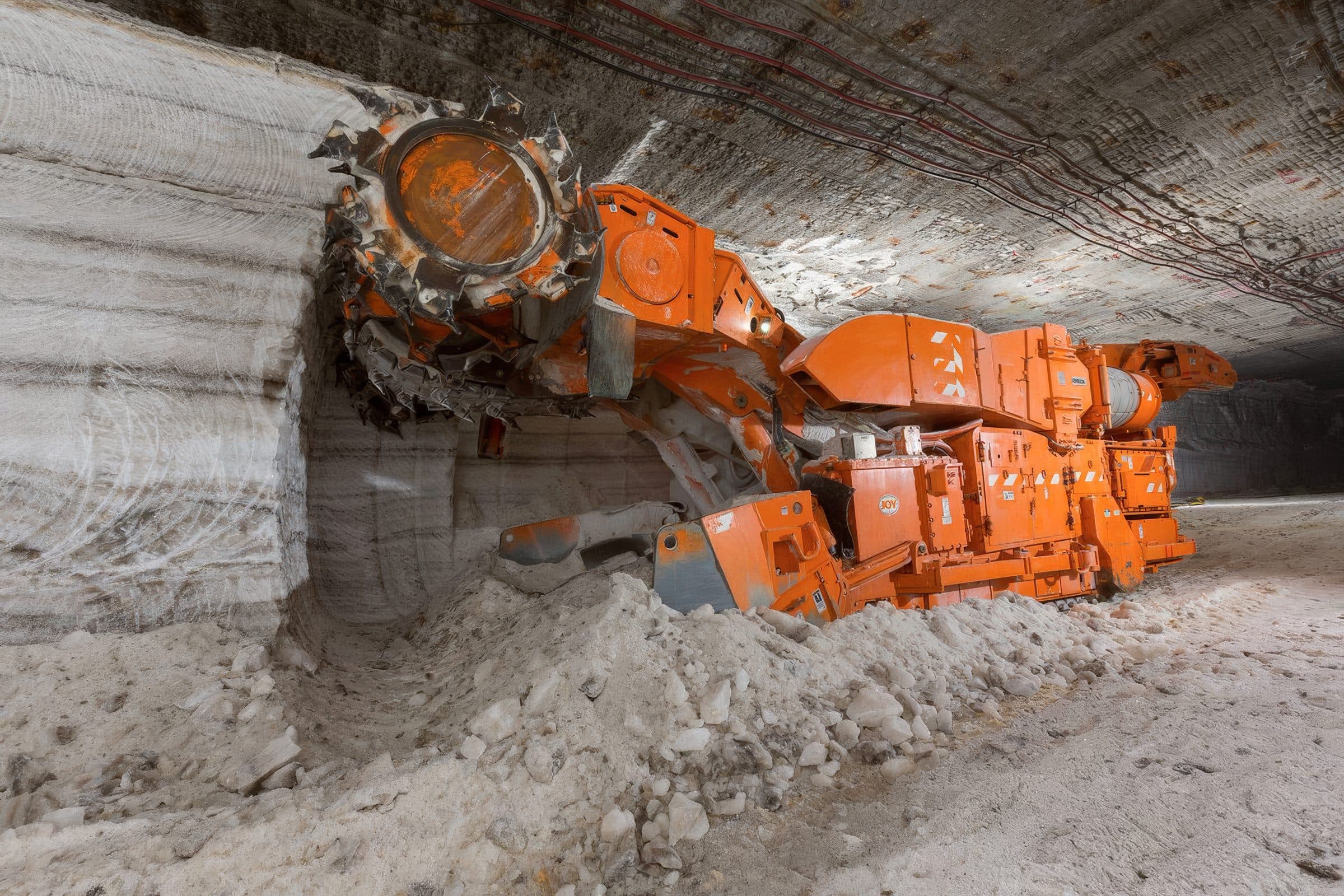
Incline-slope extraction, continuous miners
Continuous mining bores into the salt like a tunnelling machine, producing small lumps that are crushed and screened underground. Salt mines are among the safest mines — and the most comfortable to work in.
Everything a mine needs,
already in place
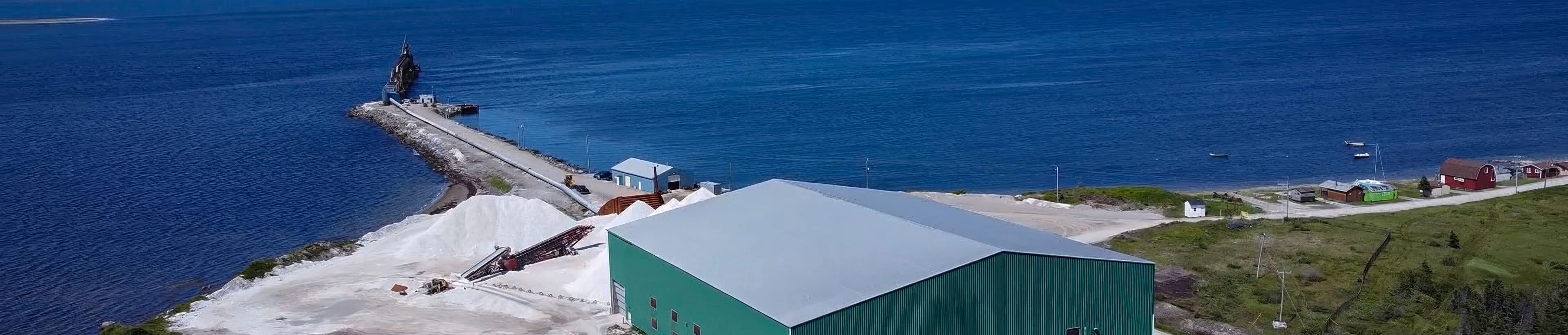
Port, power, roads, airport, workforce — the Great Atlantic site sits inside a working industrial corridor, not a remote greenfield.
Highlights
- Deepwater port (Turf Point) immediately next to the deposit along a straight haulage route
- On-site power — grid connection via dedicated substation
- Roads and the Trans-Canada Highway connect directly to the project
- Stephenville Airport is a 20-minute drive from Great Atlantic
- Mining-friendly jurisdiction with a skilled local workforce
- Pro-development industrial area — including an operating open-pit gypsum mine
- An emerging Clean Energy Hub is set to make this part of Newfoundland an economic powerhouse
“The logistics of this project are extremely compelling, allowing for a state-of-the-art ‘Salt Factory’ with easy access to large markets in Eastern Canada and the eastern United States.”
— Rowland Howe, Director
A market that relies
on imports
Roughly 25 million tonnes of de-icing salt — 150 pounds for every American — is scattered on U.S. roads annually, with 30–40% of demand filled by imports from Chile and North Africa. No economic substitutes exist in most applications.
The de-icing market today
| De-icing Markets | United States | Canada |
|---|---|---|
| Total de-icing consumption | 29 Mt | 10 Mt |
| Domestic production (rock & solar) | 16 Mt | 11 Mt (less 3.5 Mt exported) |
| Imports | 13 Mt | 3 Mt |
Sharply higher overseas shipping costs, supply chain issues, and ageing mines in the U.S. and Canada threaten long-term security of domestic supply. Low-cost Great Atlantic production, with direct access to the U.S. East Coast, could alleviate reliance on overseas imports while supplying Eastern Canada.
Figures per Atlas Salt's published market materials; totals vary by source and year.
“Great Atlantic has the potential to become the biggest and best underground salt mine in the world. The market is there, and the project would be highly scalable to meet demand for generations.”
— Rowland Howe, Director
of rock salt required by Great Atlantic's target regional markets in Eastern Canada and the U.S. East Coast in any given year — bought predominantly by government entities on annual tenders.
Beyond de-icing: high-grade salt serves every vertical
Winter road maintenance, commercial users, private households
Water treatment, drilling fluids, animal feed, pharmaceuticals
Food processing, baking, condiments & preservatives
Chlorine manufacturing, PVC plastics
Approximate annual Canadian market sizes (CAD). Like Goderich, high-grade Great Atlantic salt has the potential to serve verticals beyond road de-icing.